


By Kelvin Wilson Kasiwulaya
Women and young people remain significantly underrepresented in Southern African Development Community (SADC) parliaments, despite global progress in gender and youth inclusion, a new report shows.
The Electoral Support Network of Southern Africa (ESN-SA), citing Inter-Parliamentary Union (IPU) data, found that structural barriers continue to limit the political participation of these groups, raising concerns about the region’s commitment to inclusive governance.
While countries worldwide reached historic milestones in female political leadership in 2024, the study found that SADC lags behind, with slow progress toward gender parity and minimal youth representation in legislative bodies.
GENDER GAPS IN POLITICS PERSIST
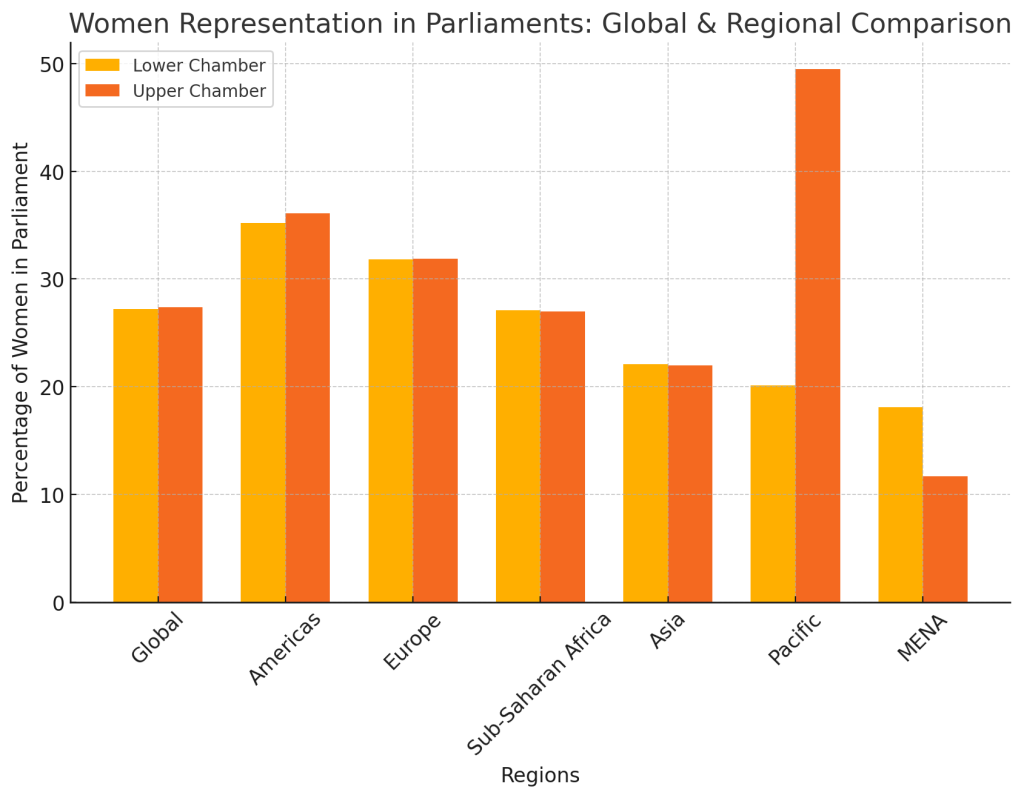
Globally, women hold 27.2% of seats in lower parliamentary chambers and 27.4% in upper chambers, the report said. In Sub-Saharan Africa, representation stands at 27.1% and 27%, respectively—well below parity. At the current pace, equal gender representation will not be achieved before 2063, the study predicted.
“Despite gradual progress, political institutions remain largely male-dominated, with deep-rooted structural biases and cultural norms limiting women’s access to leadership,” the report said.
Regional disparities remain stark, with the Americas leading at 35.2% female representation in lower chambers, followed by Europe at 31.8%. Sub-Saharan Africa lags behind, while the Middle East and North Africa record the lowest female participation at 18.1%.
At the ministerial level, women hold 23.3% of cabinet positions and 35.5% of local government seats worldwide, underscoring broader challenges in achieving equitable governance.
SADC WOMEN’S REPRESENTATION VARIES WIDELY
Female parliamentary representation in varies significantly by country, with electoral systems playing a key role. Proportional representation (PR) systems tend to yield more female legislators than first-past-the-post (FPTP) models, the report said.
Breakdowns from selec countries include:
South Africa: 44.7% of National Assembly seats and 44.4% in the National Council of Provinces (PR system).
Namibia: 40.6% of National Assembly seats, 14.3% in the National Council (PR).
Mozambique: 39.2% in the Assembly of the Republic (PR).
Zimbabwe: 30.1% of National Assembly seats, 44.3% in the Senate (Mixed/PR).
Seychelles: 28.6% in the National Assembly (Mixed).
Malawi: 20.7% in the National Assembly (FPTP).
Zambia: 15.0% in the National Assembly (FPTP).
Madagascar: 14.1% in the National Assembly, 11.1% in the Senate (FPTP).
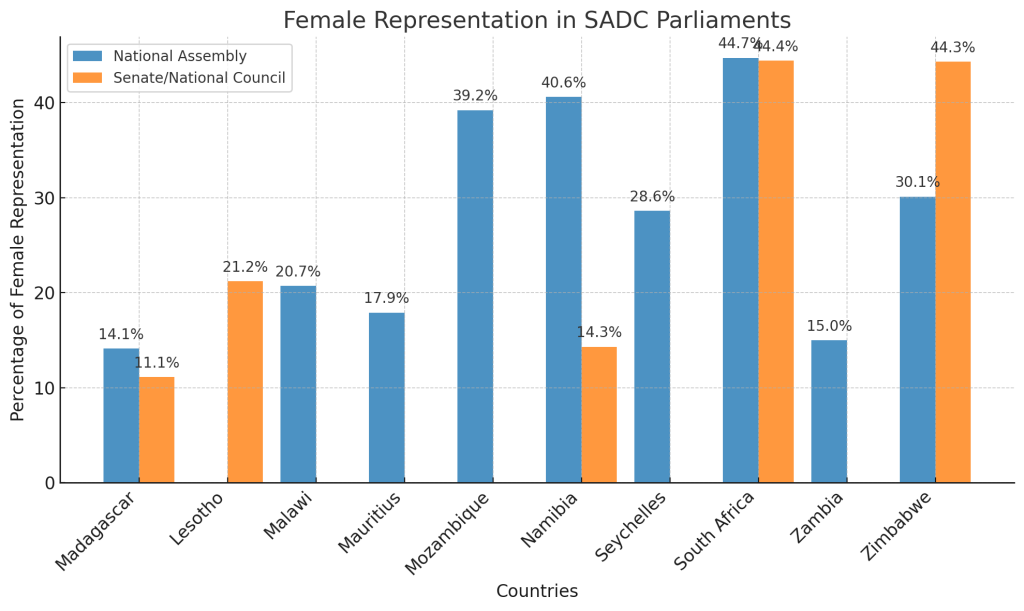
South Africa, Namibia, and Mozambique lead in female representation, while Madagascar and Zambia report some of the lowest rates, reinforcing the structural disadvantages of majoritarian electoral systems, the report said.
PARLIAMENTARY LEADERSHIP: SYMBOLIC OR SUBSTANTIVE?
Among six surveyed nations, four have female speakers in their Upper Chambers, accounting for 66% female leadership at that level. However, only one has a woman leading its Lower Chamber, where legislative power is more concentrated.
“Numbers alone don’t equate to power,” the report said. “Without real decision-making authority, female representation in leadership risks becoming symbolic rather than transformative.”
YOUTH REPRESENTATION REMAINS LOW
Youth participation in SADC parliaments is similarly limited. In Zimbabwe, a Youth Quota policy has resulted in 6.1% of MPs being 30 or younger. However, Madagascar and Mauritius have no lawmakers under 30, the report found.
For MPs aged 40 or younger:
Seychelles: 25.7%
Zimbabwe: 25.5%
Namibia: 12.9%
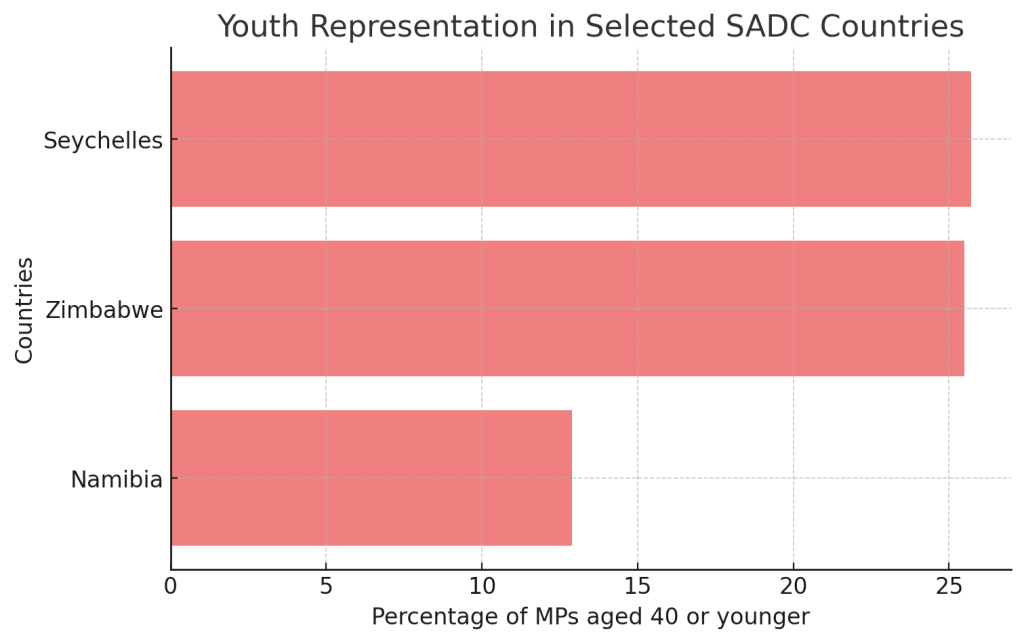
With young people comprising over 60% of the region’s population, the report warns that political underrepresentation threatens long-term democratic legitimacy.
CALL FOR REFORM
The ESN-SA report urges SADC governments to implement electoral reforms to boost women’s representation, particularly in FPTP systems, and introduce legislated gender quotas to accelerate parity. It also calls for targeted youth programs to improve access to leadership roles and mentorship initiatives for aspiring politicians.
“Ensuring fair representation of all citizens in governance structures is not just a moral obligation but a democratic imperative,” the report concluded.
Without urgent action, the gender and generational gaps in SADC politics may persist for decades, reinforcing male-dominated political elites and limiting inclusive governance.